
Edifier MR3
4.5Editor score
Hi-Res Audio certified
Bluetooth multi-point
Affordable price
Finding the right Edm Studio Monitor is crucial for producers who demand accurate sound reproduction. These speakers reveal every detail in your mix, ensuring your tracks translate well across different playback systems.
We evaluated ten leading models based on sound quality, connectivity options, and build durability. Each product was selected for its ability to deliver clear imaging and balanced frequency response in near-field environments.
Our reviews highlight standout features and potential trade-offs for each model. Note that availability and pricing may change over time, so check current listings before making your final purchase decision.
4.5Editor score

4.8Editor score

4.6Editor score
As an Amazon Associate we earn from qualifying purchases.
The following table provides a side-by-side overview of key specifications for each model, helping you quickly identify the best fit for your studio setup and workflow needs.



The PreSonus Eris E7 XT stands out as a top contender for producers seeking accuracy and versatility. With a high rating and robust build quality, it delivers a balanced sound that reveals mix details clearly.
We may earn a commission when you buy through this link, at no additional cost to you.
Its innovative EBM waveguide ensures a wide sweet spot, allowing you to hear consistent stereo imaging from various angles. The 6.5 inch woofer provides deep lows without distortion, while the silk dome tweeter offers smooth highs.
While it ships as a single unit which may increase initial costs for stereo pairs, the included acoustic tuning controls help adapt the monitor to different room sizes. This flexibility ensures accurate mixes regardless of your environment.
Producers who need reliable near-field monitoring with room compensation features should consider this model. Its combination of power, clarity, and software inclusion makes it a solid investment for professional workflows.
The EBM waveguide technology provides consistent stereo imaging across a wide listening area, making it ideal for collaborative sessions.
Studio One Prime and magic plugins add value, offering essential tools for production right out of the box.
We may earn a commission when you buy through this link, at no additional cost to you.
The Edifier MR3 offers exceptional value for entry-level producers needing reliable monitoring. Its Hi-Res Audio certification ensures flat response across a wide frequency range, crucial for accurate mix decisions.
We may earn a commission when you buy through this link, at no additional cost to you.
Connectivity is a standout feature with balanced TRS, RCA, and AUX inputs, plus Bluetooth multi-point support. The ConneX app allows precise EQ adjustments, letting you tailor the sound to your specific needs easily.
Due to its compact size, deep bass response may be limited compared to larger monitors. However, this is acceptable for near-field mixing where mid-range clarity is prioritized for vocal and instrument balance.
Beginners or those with budget constraints will appreciate its performance per dollar. It provides professional-grade features like Hi-Res support and app control without a hefty price tag.
Certified for Hi-Res Audio, these monitors deliver detailed sound reproduction suitable for high-quality music creation and playback.
The EDIFIER ConneX app provides in-depth adjustments and personalized EQ control for customized sound experiences.
We may earn a commission when you buy through this link, at no additional cost to you.
The Yamaha HS8 is a premium choice known for its deep bass extension and industry-standard sound. Its powerful 120W bi-amped system ensures dynamic range and clarity even at high volumes.
We may earn a commission when you buy through this link, at no additional cost to you.
Featuring an 8-inch cone woofer and advanced magnetic circuit, it delivers a frequency response down to 38Hz. This makes it ideal for producers working with genres that require significant low-end accuracy and punch.
While the cost is higher than entry-level options, the build quality and sonic performance justify the investment. These monitors require ample desk space but offer reliable performance for professional studios.
Experienced producers seeking a reference-grade monitor for critical listening will find the HS8 indispensable. Its reputation for accuracy and durability makes it a long-term asset for any serious setup.
With a frequency response starting at 38Hz, these monitors capture low frequencies often missed by smaller drivers.
The HS series is renowned in the industry for its consistent, accurate sound that translates well across different systems.
We may earn a commission when you buy through this link, at no additional cost to you.
The PreSonus Eris E4.5 delivers studio-quality accuracy in a compact package suitable for smaller spaces. It features woven-composite woofers that produce tight bass and a clean overall sound profile.
We may earn a commission when you buy through this link, at no additional cost to you.
With 50 Watts of dual amplification and various inputs including RCA and TRS, it offers flexibility for different setups. The front-panel headphone output and aux input add convenience for personal monitoring and quick connections.
While its power output is modest, it remains sufficient for near-field mixing tasks. The acoustic tuning controls help adapt the sound to your room, ensuring clarity without needing a large footprint.
Ideal for home studios or mobile producers, this model balances performance and portability. It provides the accuracy needed for production work while fitting comfortably on limited desk space.
Designed for near-field use, these monitors maintain tonal balance even at lower volumes, perfect for small rooms.
Multiple input options allow easy integration with professional gear and consumer electronics alike.
We may earn a commission when you buy through this link, at no additional cost to you.
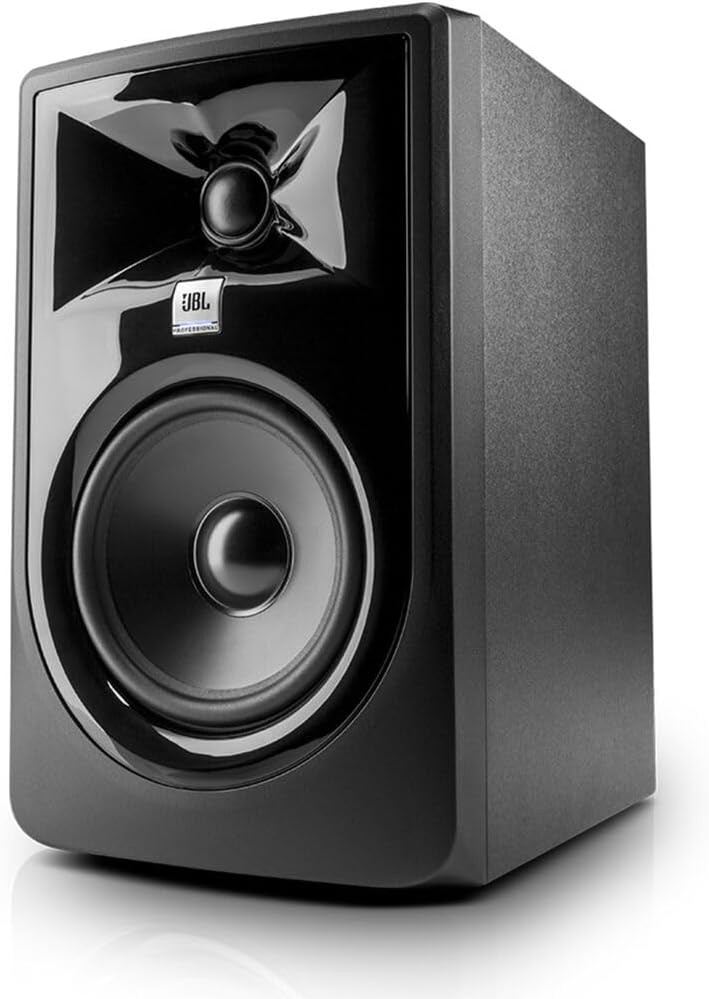
The JBL 305P MkII is renowned for its patented Image Control Waveguide which delivers immersive sound with a wide sweet spot. This makes it excellent for music production and podcasting where clarity is key.
We may earn a commission when you buy through this link, at no additional cost to you.
With 82 Watts of Class-D amplification and Boundary EQ, it ensures dynamic range and accurate mixes. The enclosure is rigorously tested for reliability, offering a sleek look that fits modern studio environments.
While deep bass may be less prominent than larger monitors, the 5-inch woofer provides balanced performance. The tuning adjustments allow for customization based on room placement, enhancing overall accuracy.
Producers needing clear imaging and a reliable reference tool will find this pair compelling. Its balance of power, design, and sound quality makes it a strong choice for diverse production tasks.
The Image Control Waveguide ensures precise stereo imaging and a wide sweet spot for consistent sound from various angles.
Boundary EQ and HF Trim settings help tailor frequencies to your room, ensuring accurate mixes regardless of placement.
We may earn a commission when you buy through this link, at no additional cost to you.
The Ortizan C7 offers versatile monitoring with stable Bluetooth 5.3 technology for wireless music playback. Its 24-bit DAC ensures minimal signal loss, maximizing sound fidelity for accurate monitoring during content creation.
We may earn a commission when you buy through this link, at no additional cost to you.
Equipped with TRS balanced inputs and AUX options, it connects easily to mixers and smartphones. The silk dome tweeter and carbon fiber speaker provide precise mid-low frequencies and transparent highs for a layered sound.
Professional tuning ensures a flat curve without artificial enhancement, faithful reproducing audio signals. This makes it suitable for small music production systems where clarity and connectivity are prioritized over raw power.
Those seeking a budget-friendly yet functional monitor with wireless capabilities will appreciate this model. It combines traditional inputs with modern convenience for a flexible listening experience.
Bluetooth 5.3 allows quick pairing with devices, enabling wireless playback without dealing with messy cables.
TRS balanced input supports connection to professional equipment like mixers for building small production systems.
We may earn a commission when you buy through this link, at no additional cost to you.
The KALI AUDIO LP-6 V2 features a robust DSP system for a flat frequency response, emitting sounds exactly as they are in your mix. It avoids alterations or boosts, ensuring authentic audio reproduction for professional production.
We may earn a commission when you buy through this link, at no additional cost to you.
With 80 Watts bi-amped power and a frequency range down to 47Hz, it delivers optimal power and loudness up to 115dB. The updated boundary EQ ensures high-quality output regardless of placement on a stand or desk.
Noise reduction upgrades minimize turbulence and hissing, providing clear sounds even at low volumes. While sold as a single unit, its performance exceeds its price point making it an attractive option for serious creators.
Producers needing a reliable, bi-amped monitor with advanced tuning should consider this model. It combines acoustic accuracy with practical design to handle diverse studio environments effectively.
Advanced DSP ensures a flat response so you hear your mix exactly as intended without artificial coloration.
Updated boundary EQ allows for high-quality audio output no matter where the monitor is placed in your room.
We may earn a commission when you buy through this link, at no additional cost to you.
The Edifier MR5 delivers studio-grade sound with a 3-way active crossover system including dedicated mid and tweeter drivers. This architecture ensures accurate detailed audio reproduction across a wide frequency range.
We may earn a commission when you buy through this link, at no additional cost to you.
Its 110W RMS Class D amplifier provides high output suitable for near-field use or mid-sized rooms. Room acoustic tuning via physical knobs or app allows tailoring sound to your space for precise listening.
Bluetooth 5.0 with LDAC and multi-point connectivity adds modern convenience alongside traditional XLR and TRS inputs. Dimpled tweeter waveguides ensure consistent quality across wider listening areas enhancing collaborative workflows.
Producers prioritizing detailed sound and room correction will find this model compelling. Its combination of power advanced tuning and versatile connectivity makes it a robust choice for demanding production.
Separate drivers for low mid and high frequencies ensure accurate detailed reproduction across the full spectrum.
Adjust controls via knobs or app to tailor sound to your space for precise listening and accurate mixes.
We may earn a commission when you buy through this link, at no additional cost to you.
The Mackie CR4.5BT combines studio-quality sound with a tone control knob for shaping audio to suit casual listening or gaming. It is designed to bridge the gap between professional and entertainment use.
We may earn a commission when you buy through this link, at no additional cost to you.
Features include TRS RCA connectors and Bluetooth for pairing smartphones. A location switch optimizes sound for desktop or bookshelf placement allowing flexibility in where you place them for best results.
While transparent response is a goal, the tone knob adds flexibility for boosting bass or sparkle. The silk dome tweeter and woven woofer produce clean articulate sound with plenty of low end.
Gamers and casual producers who want versatile speakers will find this appealing. Its blend of studio accuracy and fun features makes it an adaptable choice for various audio needs.
A tone knob lets you gradually boost bass or add high-end sparkle for immersive gaming or partying.
Flip between desktop and bookshelf modes to optimize sound based on where you place the speakers.
We may earn a commission when you buy through this link, at no additional cost to you.
The Yamaha HS5 emphasizes sonic purity without coloring or altering the original sound. This 2-way bass reflex bi-amplified monitor delivers accurate reproduction ideal for detailed near-field mixing tasks.
We may earn a commission when you buy through this link, at no additional cost to you.
With a 45W LF plus 25W HF bi-amp system totaling 70W power it provides high performance across a frequency range from 54Hz to 30kHz. Inputs accept both balanced and unbalanced signals for versatile connections.
While the 5-inch woofer limits low-frequency extension, its focus remains on accurate mid and high clarity. It is built for producers who need reliable reference tools that translate well to other systems.
Those prioritizing sonic accuracy over raw bass output will value this pair. Its reputation and build quality make it a trusted choice for professional audio workflows.
Emphasizes accurate reproduction without coloring, ensuring your mix reflects the original sound sources precisely.
Dedicated amplifiers for low and high frequencies ensure dynamic range and efficient power distribution.
We may earn a commission when you buy through this link, at no additional cost to you.
Selecting the right Edm Studio Monitor involves evaluating several technical and practical factors that impact your workflow and sound quality.
Driver size typically ranges from 3 to 8 inches, influencing low-end response. Larger drivers provide deeper bass but require more space, while smaller ones suit compact near-field setups. Power ratings in watts indicate volume capacity and headroom for dynamic mixes.
A flat frequency response ensures accurate reproduction without artificial coloration. Look for models that cover a wide range from lows to highs to capture all elements of your mix. Consistency across frequencies is key for reliable translation to other systems.
Check for balanced inputs like TRS or XLR to minimize noise. Additional inputs like RCA and AUX provide flexibility for connecting various devices. Some models also offer Bluetooth for wireless convenience in casual listening scenarios.
Adjustable EQ or boundary controls help adapt the monitor to your specific room. Features like HF LF trim allow fine-tuning based on placement near walls or corners. Proper tuning reduces reflections and improves mix accuracy in treated or untreated spaces.
Cabinets made from MDF reduce resonance and distortion for clearer sound. A sturdy enclosure ensures durability over time. Sleek designs may blend better with home studios while professional-grade build adds reliability.
Consider what features matter most to your workflow. Entry-level models offer solid performance at lower costs while premium options provide advanced tuning and power. Weigh long-term benefits against initial investment for better value.
Some monitors include production software suites or app control for customization. Headphone outputs and tone controls add practicality for diverse tasks. Evaluate if these extras justify a higher price or if basic monitoring suffices.
Position your monitors equidistant from your ears and angled inward to form an equilateral triangle. This alignment ensures accurate stereo imaging and a focused sweet spot for mixing.
Avoid placing monitors directly against walls to reduce low-frequency buildup. Use stands or isolation pads to decouple speakers from desks and prevent unwanted vibrations.
Regularly dust the grilles and cabinets with a soft cloth. Check cables periodically for wear and ensure connections remain tight to maintain optimal signal quality.
For small studios, monitors between 4 to 5 inches are ideal as they fit comfortably on limited desk space. These sizes provide adequate clarity for near-field mixing without overwhelming the room with excess bass.
Balanced inputs like TRS or XLR reduce noise interference during signal transmission. While unbalanced options work for casual use, balanced connections ensure cleaner audio paths essential for professional mixing workflows.
Room tuning controls allow you to adjust frequency response based on your room's acoustics. By compensating for reflections or low-frequency buildup, you achieve a flatter curve that reveals true mix details.
Studio monitors provide a flat frequency response without added coloration, unlike consumer speakers that often boost bass or highs. This neutrality allows producers to make precise decisions ensuring tracks translate well across all systems.
Bluetooth is generally not recommended for critical production due to potential latency and compression. Use wired connections like TRS or XLR for mixing, while Bluetooth can serve for casual listening or reference checks.
The sweet spot refers to the optimal listening position where stereo imaging is most accurate. It is usually centered between the two monitors at ear level forming an equilateral triangle for precise sound perception.
Our top picks highlight models like the PreSonus Eris E7 XT for versatility and the Edifier MR3 for value. Each offers distinct strengths to suit various production needs and budgets.
When selecting, prioritize accuracy and connectivity features that align with your specific workflow. Investing in monitors with room tuning options ensures long-term performance across changing environments.
Remember that prices and availability fluctuate over time. Always check current listings and verify specs before purchasing to secure the best deal for your studio setup.