
RIGOL DHO924S
4.5Editor score
250 MHz bandwidth
Built-in signal generator
Bode plot analysis
Digital oscilloscopes are essential tools for engineers and hobbyists who need to visualize and analyze electrical signals. These instruments display voltage changes over time, allowing users to diagnose circuit issues effectively.
We compared ten top-rated models based on bandwidth, sampling rate, resolution, and user interface features. Our analysis focuses on performance, portability, and value to ensure you find the right scope for your needs.
Each pick highlights key strengths and ideal use cases for different budgets. Prices and availability may vary, so verify current details before purchasing to ensure you get the best deal available today.
4.5Editor score
4.3Editor score

4.1Editor score
As an Amazon Associate we earn from qualifying purchases.
This table provides a side-by-side comparison of all ten digital oscilloscopes featured in this guide, highlighting their core specifications and primary use cases.


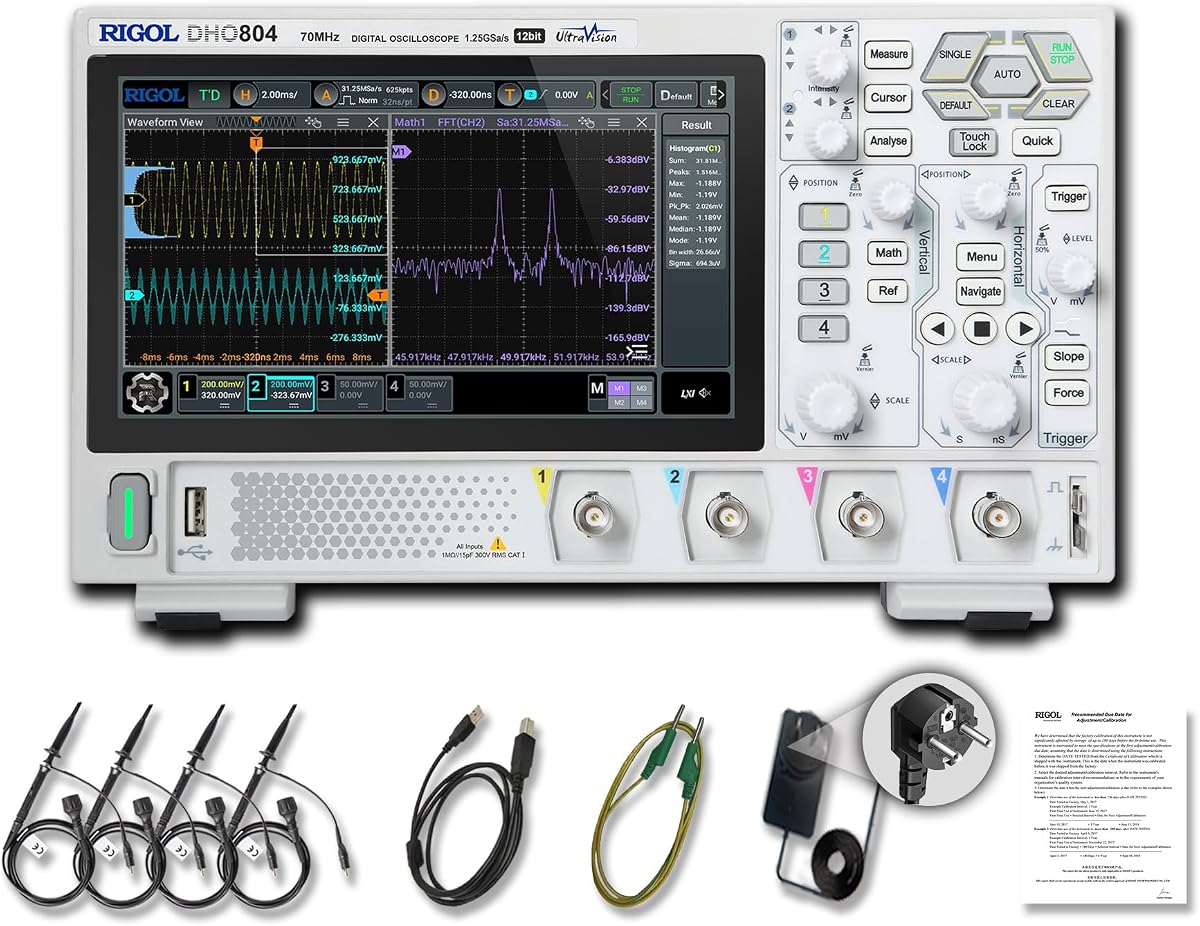
The RIGOL DHO804 stands out as an exceptional choice for modern electronics work. It combines high resolution with fast acquisition speeds to deliver clear and detailed signal views. This model is ideal for users who need precise measurements without sacrificing usability.
We may earn a commission when you buy through this link, at no additional cost to you.
Its 12-bit vertical resolution provides significantly better detail than standard 8-bit scopes. The UltraAcquire technology captures up to one million waveforms per second, making it easy to spot intermittent glitches. Serial decode support for CAN, RS232, I2C, and SPI adds valuable debugging capabilities.
While the price is higher than entry-level options, the performance justifies the investment. The 7-inch touchscreen and Flex Knob improve daily interaction speed. Some users might find the weight slightly less portable than compact handhelds.
This oscilloscope is perfect for embedded systems debugging and power supply analysis. Engineers working on complex circuits will appreciate the deep memory and fine vertical detail. It offers a balanced mix of professional features and intuitive controls.
The 12-bit resolution allows you to see small voltage variations that standard scopes might miss. This is crucial for analyzing ripple and noise in power rails.
The touchscreen interface and Flex Knob allow for quick adjustments. You can navigate through long acquisitions and zoom into specific events with minimal effort.
We may earn a commission when you buy through this link, at no additional cost to you.
The DHO924S offers advanced capabilities for rigorous testing environments. With 250 MHz bandwidth and 12-bit resolution, it handles fast edges and fine details with equal ease. The integrated arbitrary function generator simplifies loop response testing significantly.
We may earn a commission when you buy through this link, at no additional cost to you.
Key strengths include the Bode plot analysis feature which is rare in this class. It allows direct frequency response measurements without external hardware. The 50 Mpts memory depth ensures you can capture long records without sacrificing sample rate.
The high price point reflects its advanced features. You may need to purchase a separate probe for the digital channels. However, the comprehensive toolkit makes it a powerful asset for R&D labs.
Ideal for professionals doing high-speed embedded timing and power loop checks. The built-in generator saves time and equipment costs. If budget allows, this unit delivers top-tier performance.
The built-in AFG allows you to generate signals while observing responses. This simplifies feedback loop and stability testing significantly.
With 50 Mpts of memory, you can capture longer events at high sample rates. This ensures no transient detail is lost during long acquisitions.
We may earn a commission when you buy through this link, at no additional cost to you.
This handheld oscilloscope brings impressive specs to a portable form factor. It features 350 MHz bandwidth and 1 GSa/s sampling, which is rare for battery-powered devices. The spectrum analyzer adds valuable EMI debugging capabilities at a low cost.
We may earn a commission when you buy through this link, at no additional cost to you.
The 7-inch touchscreen makes it easy to interpret signals clearly. Built-in signal generator functionality lets you test circuits without extra gear. The large battery ensures long usage during fieldwork or travel.
Trade-offs include a smaller memory depth compared to benchtop models. This limits very long capture times. However, for most field applications, the performance is more than adequate.
Excellent for field technicians and hobbyists needing portability. It handles a wide range of tasks from audio to RF checks. If you need high bandwidth on a budget, this is a strong candidate.
The built-in battery makes this unit fully portable. You can take it to remote sites without worrying about power sources.
The FFT-based spectrum analyzer helps identify noise sources quickly. This is essential for troubleshooting electromagnetic interference issues.
We may earn a commission when you buy through this link, at no additional cost to you.
This model is known for its reliability and solid performance. With 100 MHz bandwidth and deep memory, it handles most common debugging tasks well. The high user rating reflects consistent quality and ease of use.
We may earn a commission when you buy through this link, at no additional cost to you.
Its deep memory up to 24 Mpts helps capture long events. This is useful for analyzing complex embedded system behaviors. Standard USB and LAN interfaces simplify data export and documentation workflows.
The two-channel limit might be restrictive for some applications. Some users may prefer a touchscreen interface found on newer models. Yet its stability and performance remain strong.
Best for educational labs and general electronics maintenance. It provides a professional experience without unnecessary complexity. If you need a dependable scope for daily use, this is a top pick.
Deep memory allows for longer capture times without losing detail. This is crucial for analyzing intermittent faults over extended periods.
LAN and USB ports make sharing data and remote control easy. This helps in automated testing and documentation tasks.
We may earn a commission when you buy through this link, at no additional cost to you.
The 2C53T integrates an oscilloscope, multimeter, and signal generator into one unit. This versatility is great for hobbyists who need multiple tools without buying separate devices. The low price makes it very accessible for entry-level users.
We may earn a commission when you buy through this link, at no additional cost to you.
It supports basic waveform storage and export via USB-C. The multimeter functions cover common voltage and resistance needs. Its FPGA architecture ensures reasonable performance for simple tasks.
The bandwidth is limited to 50 MHz which restricts high-speed work. The display resolution is lower than modern standards. However, for basic hobby circuits, it works well.
Ideal for students and DIYers on a tight budget. It covers a wide range of basic electronics needs in one package. If you need a starter kit for various measurements, this fits the bill.
Having an oscilloscope and multimeter in one device saves space and cost. This is perfect for home workshops and field repairs.
Built-in waveform storage allows for easy comparisons. You can save screenshots and compare them directly on the screen.
We may earn a commission when you buy through this link, at no additional cost to you.
This pocket oscilloscope is designed for quick checks and basic tasks. It fits easily in a tool pouch and requires no assembly. Its simple interface allows you to start measuring quickly with auto setup.
We may earn a commission when you buy through this link, at no additional cost to you.
The 200 kHz bandwidth suits low-frequency circuits like audio. The built-in battery provides around four hours of continuous use. This makes it handy for maintenance work where mains power is unavailable.
Its limited bandwidth excludes high-speed digital signal work. The screen resolution is modest compared to larger units. However, its portability is unmatched for field repairs.
Best for maintenance technicians and casual hobbyists. It handles basic voltage checks and signal tracing effectively. If you need a small scope to keep in your pocket, this is a practical choice.
The lightweight design allows for easy transport to different sites. This is ideal for maintenance workers who need quick access.
Auto setup buttons simplify measurements for beginners. You can get a waveform display without manual tuning.
We may earn a commission when you buy through this link, at no additional cost to you.
This model offers 150 MHz bandwidth with useful decoding features. It supports five serial protocols which aids embedded system debugging. The arbitrary waveform output allows for custom signal generation needs.
We may earn a commission when you buy through this link, at no additional cost to you.
The unit is designed for lab and education use. It balances performance with an affordable price point. Many users find it reliable for routine technical tasks.
The interface may require some time to learn fully. Build quality is adequate but not premium. Despite this, it offers good value for its capabilities.
Great for students and engineers needing bandwidth on a budget. It handles most standard debugging tasks efficiently. If you need protocol decoding without high costs, this is worth considering.
Support for five serial protocols simplifies embedded debugging. This helps interpret complex digital data quickly.
Arbitrary waveform output enables custom signal testing. You can create specific patterns for circuit validation.
We may earn a commission when you buy through this link, at no additional cost to you.
This unit features a 7-inch touchscreen for modern interaction. The resolution allows for clear viewing of waveforms. Built-in storage supports thousands of screenshots which aids documentation.
We may earn a commission when you buy through this link, at no additional cost to you.
The battery life supports four hours of continuous work. This makes it suitable for mobile repairs. The capacitive touch simplifies gesture-based navigation.
While specs are average, the display quality stands out. Software responsiveness can vary with complex setups. Still, the form factor is very appealing for daily use.
Ideal for users who prefer touch interfaces. It combines decent performance with a modern design. If you want a portable scope with a good screen, this is a strong option.
The touchscreen allows for intuitive control and navigation. This speeds up measurement tasks significantly.
With ample storage space you can save many screenshots. This helps in tracking changes and comparing results easily.
We may earn a commission when you buy through this link, at no additional cost to you.
Selecting the right oscilloscope depends on your specific needs and budget. Consider these key factors to ensure you get a tool that matches your requirements.
Bandwidth determines the maximum frequency the scope can measure accurately. For digital signals, choose a bandwidth at least five times higher than your signal's fastest edge. This ensures you capture enough harmonic content for precise analysis.
Choose bandwidth based on your highest expected signal frequency.
Sampling rate refers to how many samples the scope takes per second. A higher rate captures finer details and reduces aliasing. Look for a rate at least two to five times the bandwidth for reliable results.
Higher sampling rates provide more accurate waveform reconstruction.
Resolution indicates the vertical precision of the measurements. Higher bit resolution like 12-bit reveals small voltage changes that 8-bit models might miss. This is crucial for power supply ripple analysis.
Higher resolution improves detail in low-amplitude signals.
Channels determine how many signals you can view simultaneously. Four-channel models are ideal for digital bus debugging. Two-channel scopes are sufficient for basic analog work.
Choose channel count based on simultaneous signal needs.
Memory depth defines how many points can be stored per acquisition. Deeper memory allows longer capture times without sacrificing sample rate. This helps in analyzing long-duration events or rare glitches.
More memory helps capture longer events at high resolution.
Triggers help stabilize waveforms for clearer viewing. Advanced triggers like pulse width or serial protocol decoding simplify debugging complex signals. These features save time and improve accuracy.
Advanced triggers streamline complex signal analysis tasks.
Connectivity options like USB and LAN allow data export and remote control. This is essential for documentation and automated testing. Ensure the ports match your workflow requirements.
Good connectivity enhances documentation and remote testing.
Portability matters if you move between locations frequently. Handheld models offer battery power and compact designs. Benchtop units typically offer better performance and display quality.
Select portability based on where you work most often.
Start by connecting the probes correctly and calibrating them before each session. Proper calibration ensures accurate measurements and prevents damaging the scope inputs. Always check probe attenuation settings to match the display configuration.
Use the auto-setup feature for quick signal visualization then fine-tune controls manually. Adjust the time and voltage divisions to focus on the waveform details you need. Save frequently used settings for faster workflow in repeat tasks.
Store your oscilloscope in a dry and dust-free environment. Avoid exposing it to extreme temperatures or shocks. Regularly update firmware to maintain performance and access new features.
Bandwidth refers to the maximum frequency the scope can measure accurately. Sampling rate is how many data points the scope collects per second. Both are critical for capturing fast signal edges without loss of detail.
An 8-bit scope is sufficient for basic signal visualization and timing work. A 12-bit scope is better for analyzing ripple and noise where small voltage changes matter. Choose based on your precision requirements.
Two channels are enough for most analog and single-source digital tasks. Four channels are necessary for debugging multi-signal buses or power stages. Match the channel count to your simultaneous measurement needs.
Memory depth is the amount of data points captured per trigger event. More memory allows longer time windows without reducing sample rate. This helps in finding rare intermittent glitches during tests.
Modern handheld scopes offer high precision suitable for fieldwork. They are often limited by bandwidth compared to benchtop models. For basic maintenance and hobby tasks, they are highly reliable.
Look for protocols decode support and adequate bandwidth. Features like serial trigger and deep memory simplify digital logic analysis. Ensure the scope matches your microcontroller speed requirements.
We have reviewed ten top models ranging from handheld tools to professional lab units. Each option offers unique benefits depending on your workflow and budget constraints.
Prioritize bandwidth and memory depth for performance while considering portability for field use. Ensure the unit supports protocols you work with most often.
Prices change frequently so verify current offers before finalizing your purchase. Choosing the right tool today will serve your technical needs for years to come.