
SVBONY SV503 Telescope for Adults High Powered 102mm Large Diameter F7 ED
4.8Editor score
102mm aperture F7 focal ratio
Dual-speed focuser and field rotator
S-FPL51 ED glass optics
Discover the top apochromatic refractors for astrophotography and visual astronomy. We compare optical quality, portability, and features to help you choose.
Apochromatic refractors are the gold standard for clear, color-corrected views of the night sky. These telescopes use special glass and lens designs to eliminate color fringing around stars and planets. Whether you are observing deep sky objects or capturing detailed images, an APO refractor delivers exceptional sharpness and contrast.
We have carefully selected ten top-rated models based on optical performance, build quality, and value. This list includes options for beginners, visual observers, and serious astrophotographers. Each entry features detailed specifications and real-world strengths to help you make an informed decision.
Every product in this guide offers unique advantages for different viewing needs. You will find short review summaries, key pros and cons, and practical buying advice. Please note that product availability and specific details may change over time, so verify current listings before purchasing.
4.8Editor score

4.5Editor score

4.9Editor score
The following table provides a side-by-side overview of each telescope's key characteristics. Use this to quickly compare aperture sizes, focal ratios, optical designs, and included accessories across our top picks.




This SVBONY SV550 AP0 telescope is a top choice for those seeking excellent optical performance without breaking the bank. Rated 4.5 stars, it uses a triplet apochromatic design with S-FPL51 low-dispersion glass to deliver sharp, color-corrected views.
We may earn a commission when you buy through this link, at no additional cost to you.
The air-spaced triple optical design virtually eliminates chromatic aberration, resulting in bright, high-contrast images ideal for galaxies and nebulae. The dual-speed toothed focus mount reduces vignetting on full-frame cameras and minimizes support weight.
While it lacks included accessories like a finder or mount, the OTA itself is robust. Multiple internal extinction barriers ensure clean images by reducing stray light reflections inside the barrel.
Anyone looking for a serious visual or imaging telescope should consider this model. Its balance of optical quality and portability makes it a standout in the mid-range market.
The S-FPL51 glass and triplet structure effectively eliminate blue-edge color fringing seen in single-ED designs.
The 2.5-inch focuser and light barriers are optimized for full-frame camera use and high-contrast astrophotography.
We may earn a commission when you buy through this link, at no additional cost to you.
The Explore Scientific ED80 Essential Series delivers brilliant views thanks to its genuine FCD1 HOYA ED glass and enhanced coatings. This model is rated 4.2 stars and excels at producing high-contrast, detailed images of deep sky objects.
We may earn a commission when you buy through this link, at no additional cost to you.
Its air-spaced triplet design virtually eliminates chromatic aberration, making it suitable for capturing stunning images of the Moon, planets, and nebulae. The front cell features push-pull adjustments that allow users to optimize collimation for tight stars.
While the scope is well-built, users should note it is designed for portability but might need additional support hardware for heavy imaging loads. The USA-based support adds peace of mind for long-term ownership.
This telescope is ideal for astronomers who value optical precision and customer service. Its versatility makes it a strong choice for both visual and astrophotography applications.
FCD1 HOYA glass combined with proprietary multi-layer coatings ensures excellent light transmission and minimal internal reflections.
With retractable dew shields and a 480mm focal length, it is perfect for spontaneous sessions or dual-use imaging setups.
We may earn a commission when you buy through this link, at no additional cost to you.
This SVBONY SV550 bundle is rated a perfect 5.0 stars and is a top pick for astrophotographers wanting a ready-to-shoot setup. The SV209 field flattener ensures the field remains flat, correcting curvature for sharp edge-to-edge images.
We may earn a commission when you buy through this link, at no additional cost to you.
The telescope itself uses an air-spaced triplet design with S-FPL51 glass to minimize color fringing. The magnesium alloy focusing seat reduces weight by over 20 percent compared to aluminum, making it easier to carry and mount.
While it is a great imaging package, users must supply their own mount and tripod. However, the inclusion of extension tubes and adapter rings simplifies the setup process for standard astronomical cameras.
This bundle is best suited for those focused on deep sky imaging who want optical perfection without buying components separately. Its combination of quality and convenience stands out in the market.
The SV209 field flattener is specifically designed to correct field curvature for both half-frame and full-frame sensors.
The magnesium alloy seat keeps the overall load light, ideal for portable tripods and travel observatory use.
We may earn a commission when you buy through this link, at no additional cost to you.
This SVBONY SV550 bundle features a 122mm aperture that offers more light gathering than standard 80mm models. The included SV211 dovetail base adds stability and makes installation of guide scopes straightforward.
We may earn a commission when you buy through this link, at no additional cost to you.
The FPL-51 triplet apochromatic lens structure contains one piece of ED glass to significantly reduce chromatic aberration. This enhances clarity and sharpness, making it suitable for faint deep sky objects.
While heavier at 6.44kg, the included portable handle and carrying case make transport easier. Users benefit from the higher limiting magnitude which allows observation of dimmer targets.
This kit is best for those ready to upgrade to a larger aperture without buying everything separately. The combination of optical quality and included accessories is a strong value proposition.
The 122mm aperture allows you to see and capture fainter deep sky objects that smaller telescopes might miss.
The SV211 base comes with mounting screws and a wrench for easy guide scope installation.
We may earn a commission when you buy through this link, at no additional cost to you.
The Askar 71F is a high-end OTA rated 4.9 stars that prioritizes portability and optical perfection. Its quadruplet air-spaced APO design provides superb correction across the field.
We may earn a commission when you buy through this link, at no additional cost to you.
As a self-flattened OTA, it is ready for photography without needing extra flatteners. The interior uses matte paint to reduce stray light, while the 360-degree rotator aids composition.
Weighing only 2.5kg, it is incredibly easy to carry. However, the 71mm aperture means it is best for bright targets rather than very faint deep sky objects.
This scope is perfect for advanced users who need a light, high-performance scope for imaging sessions. Its versatility for birding and landscape viewing adds extra value.
The quadruplet design ensures minimal field curvature and color error across the entire frame.
With a built-in field flattener, you can set up imaging faster without adding extra lenses.
We may earn a commission when you buy through this link, at no additional cost to you.
Rated 4.8 stars, the SVBONY SV503 offers a generous 102mm aperture for bright, high-contrast images. It uses S-FPL51 ED glass to minimize color fringing on planets and deep sky targets.
We may earn a commission when you buy through this link, at no additional cost to you.
The dual-speed focuser is coupled with a 360-degree field rotator, allowing easy alignment without tube rotation. With 90mm of focus travel, it accommodates heavy accessories like filter wheels easily.
While it needs a separate mount and field flattener for imaging, the optics are superb. The retractable hood prevents dew and blocks stray light for clear views.
This telescope is ideal for users who want a balanced instrument for both visual viewing and imaging. Its build quality and features exceed typical expectations at this size.
FMC coating and ED glass deliver true-to-life colors and sharp detail with minimal aberrations.
The 90mm travel ensures you can focus even with heavy camera accessories attached.
We may earn a commission when you buy through this link, at no additional cost to you.
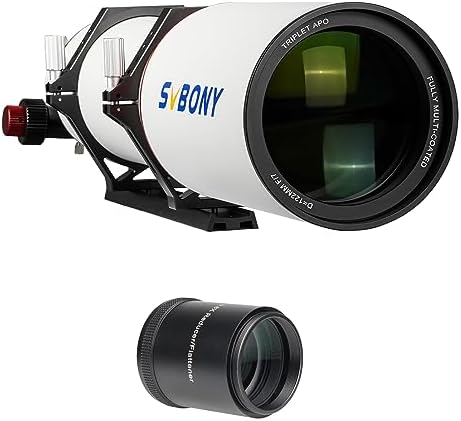
This SVBONY SV550 bundle comes with a 0.8X focal reducer field flattener, making it excellent for wide-field imaging. The 122mm aperture gathers more light for bright, detailed deep sky objects.
We may earn a commission when you buy through this link, at no additional cost to you.
The SV209 corrects field curvature and improves edge imaging quality. The FPL-51 triplet lens ensures sharpness and reduced chromatic aberration across the frame.
Despite its weight, the included case makes transport practical. Users appreciate the convenience of having all necessary imaging accessories included.
This kit is best for those ready to invest in a serious wide-field imaging setup. It saves time by bundling critical optical components.
The 0.8X reducer expands the field of view for capturing large nebulae and galaxy clusters.
FPL-51 glass provides high contrast and minimal color fringing for pristine images.
We may earn a commission when you buy through this link, at no additional cost to you.
This SVBONY SV550 122mm kit is designed for those who want a complete imaging solution. It includes a SV209 0.8X focal reducer to correct field curvature and widen the field.
We may earn a commission when you buy through this link, at no additional cost to you.
The FPL-51 triplet apochromatic lens ensures sharp, color-accurate images. The portable handle and included dovetail base make setup straightforward and stable.
While the price is higher, the convenience of bundled accessories offsets the cost. It is built to handle deep sky targets with high limiting magnitude.
This kit is ideal for serious astrophotographers wanting a ready-to-image setup. It combines light gathering power with precision optics.
The inclusion of the focal reducer saves time and money compared to buying separately.
The ergonomic handle and dovetail base allow easy movement between observing locations.
We may earn a commission when you buy through this link, at no additional cost to you.
This SVBONY SV550 80 Kit is a practical choice for those seeking an APO telescope with essential accessories. The SV209 field flattener corrects field curvature for better edge sharpness.
We may earn a commission when you buy through this link, at no additional cost to you.
The triplet apochromatic optics structure with S-FPL51 ED glass reduces color fringing. It is fully coated to bring bright and clear images with minimal reflection.
While smaller at 80mm, it is still useful for bright deep sky objects. The included handle makes it easy to carry to observing sites.
This kit is best for beginners wanting a ready-to-imaging APO system. Its balance of optical quality and accessories is attractive.
The included handle and flattener simplify setup and improve image quality right out of the box.
Triplet design ensures high contrast and sharpness for both visual and imaging work.
We may earn a commission when you buy through this link, at no additional cost to you.
This SVBONY SV550 bundle includes a SV165 Mini Guide Scope and SV905C Telescope Camera for complete autoguiding. The camera has high QE and low noise for tracking faint guide stars.
We may earn a commission when you buy through this link, at no additional cost to you.
The main telescope has a 122mm aperture for gathering light on faint deep sky objects. The FPL-51 triplet lens ensures sharpness and reduced color errors.
While extra mounts are needed, the bundled imaging accessories save money. It is ready for serious astrophotography setups.
This kit is best for users focused on precise tracking and long exposure imaging. The included guiding tools are essential for quality results.
The guide scope and camera ensure precise tracking for long exposure astrophotography.
The 122mm aperture allows capture of fainter targets with high detail.
We may earn a commission when you buy through this link, at no additional cost to you.
Selecting the right apochromatic refractor depends on your observing goals and equipment compatibility. Consider these factors before making a purchase.
Aperture determines light gathering and resolution. Larger apertures reveal fainter objects but increase weight and cost. For beginners, 80mm to 100mm is often ideal.
Choose the largest aperture you can comfortably mount and carry.
APO refractors use triplet or quadruplet lens groups with ED glass to reduce chromatic aberration. Look for designs that include extra-low dispersion glass for clean colors.
Triplet designs offer excellent correction and are standard for quality APOs.
Focal ratio affects image scale and exposure times. Faster scopes (f/6 to f/7) are better for wide-field imaging, while slower ones suit planetary work.
Select a ratio matching your desired field of view and target type.
Deep travel allows focusing with heavy accessories like filter wheels. A dual-speed focuser ensures precise control during imaging sessions.
Ensure the focuser matches your camera weight and accessory needs.
Weight and size matter if you travel to dark skies. Lightweight materials like magnesium alloy help reduce overall load on mounts.
Balance optical size with how easily you can transport the telescope.
Bundles often include field flatteners, focal reducers, or carrying cases. These save money and simplify setup compared to buying parts separately.
Check if essential imaging components are included in the kit.
Ensure the telescope dovetail matches your mount. Standard Vixen or Losmandy styles work with most mounts. A sturdy mount is crucial for stability.
Verify the dovetail size and mounting bracket before purchase.
APO refractors range from affordable to premium. Higher prices usually bring better optics and accessories. Consider total cost including mount and camera.
Invest in quality optics but balance with your overall setup budget.
Always allow your telescope to reach ambient temperature before imaging to reduce thermal currents. Place it outside about an hour before your session.
Use dew heaters or retractable hoods to prevent condensation on the lens. Check for moisture before each observing night.
Store the telescope in a dry place and cover the objective with a protective cap. Regularly check focusers and optical alignment for smooth operation.
APO refractors use extra-low dispersion glass and multiple lens elements to eliminate chromatic aberration. This results in sharp, color-corrected images without the color fringing common in standard designs.
Yes, APO refractors are highly favored for astrophotography due to their flat fields and color accuracy. Many models include accessories like field flatteners to optimize for camera use.
Field flatteners are essential if your camera shows curved star edges. Most APOs designed for imaging include or recommend one to correct field curvature.
80mm to 100mm apertures offer a good balance of performance and portability. They are light enough to carry and provide bright views for visual and imaging.
Yes, many APO refractors can be used for daytime viewing. Ensure you have the correct eyepieces or adapters for comfortable terrestrial observation.
Most telescope kits are sold as optical tubes without mounts. You will need a compatible equatorial or alt-azimuth mount to use them effectively.
Our top picks include the SVBONY SV550 AP0 for balanced performance, the SVBONY SV503 for value, and the Askar 71F for lightweight imaging.
Prioritize optical quality and mount compatibility to ensure long-term satisfaction. A good mount is just as important as the telescope itself.
Always verify current product details and prices before purchasing since models and bundles can change over time.